Kettlebell Halo: Complete Guide
The kettlebell halo is an often underrated shoulder mobility and strengthening exercise. The concept is simple: you rotate the kettlebell around your head in a continuous circle, like a halo. Despite its apparent simplicity, this movement works thoracic mobility, scapular stability, and deep shoulder muscle strengthening in a unique way. It is the perfect warm-up before any pressing session.
The halo is also a top-tier corrective exercise. If you struggle to raise your arms overhead without compensating with your lower back, the halo will help unlock the necessary mobility over time. Kettlebell coaches systematically include it in their warm-ups, and for good reason: it prepares the shoulder joint through its full range of rotation.
Muscles targeted
- Deltoids (all three heads): work in continuous rotation around the head, each portion is engaged at a different point of the circle
- Upper and lower traps: elevation, retraction, and scapular depression during the rotation
- Rhomboids: scapular retraction when the kettlebell passes behind the head
- Rotator cuff: dynamic stabilization of the glenohumeral joint
- Serratus anterior: scapular protraction when the kettlebell passes in front
- Abs and obliques: anti-rotation and anti-lateral flexion bracing to keep the trunk still
- Triceps and biceps: continuous elbow flexion-extension
The halo is primarily an active mobility exercise: it strengthens muscles in ranges that most traditional exercises ignore. That is what makes it so valuable for joint health.
Proper execution
Starting position
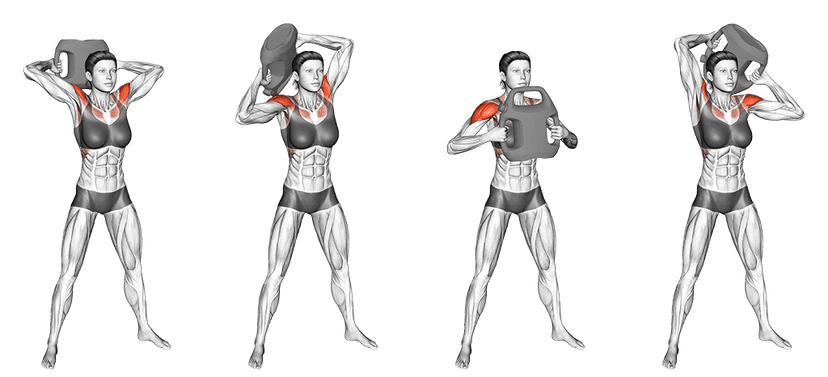
Stand with feet shoulder width apart, knees slightly bent. Grip the kettlebell by the horns (the sides of the handle), ball facing down, in front of your chest. Elbows are bent and close to the body. Brace your abs and squeeze your glutes to lock the trunk.
The circular movement
- Move the kettlebell toward one side of your head (for example, to the right).
- Continue passing it behind your head, keeping the load as close as possible to your skull. Elbows stay bent and close.
- Bring the kettlebell to the other side (left) and return it in front of your chest to complete the circle.
- The trunk stays perfectly still. Only the arms and shoulders move.
- Complete the prescribed reps in one direction, then reverse.
Breathing: breathe naturally and continuously. No breath-holding. Inhale when the kettlebell passes in front, exhale when it passes behind (or vice versa, as long as it is consistent).
Tempo: slow and controlled. The halo is not a speed exercise. Each rotation should take 3-4 seconds. Feel every position and control the load at every moment.
Common mistakes
1. Moving the trunk
If your torso leans or rotates when the kettlebell passes behind your head, the load is too heavy or you lack mobility. The halo is an anti-movement exercise for the trunk. Your hips and spine do not move. Only the arms rotate.
2. Moving the kettlebell away from the head
The farther the kettlebell is from your head, the longer the lever arm and the more your shoulders suffer. Keep the load as close as possible to your skull, nearly grazing it. Think about drawing the smallest circle possible.
3. Going too fast
Spinning the kettlebell at full speed removes the mobility and control benefit. Slow down. Feel the stretch when the load passes behind your head. Control every centimeter of the path.
4. Tracking the kettlebell with your eyes
Your head stays facing forward. Do not follow the kettlebell with your eyes, or you will end up turning your head and drifting off path. Fix a point in front of you and let the load travel around your peripheral vision.
5. Forgetting to switch directions
Always rotating in the same direction creates imbalances. Alternate systematically: 10 reps to the right, 10 reps to the left, or one rep in each direction alternating.
Variations
Kneeling halo (beginner to intermediate)
Perform the halo in a half-kneeling position (one knee down) or tall kneeling (both knees down). Reduces the base of support and increases the bracing demand. Excellent for isolating upper body work without lower body compensation.
Seated halo (beginner)
Seated on a bench or chair. Eliminates all lower body compensation. Perfect for people with lower body mobility limitations or for total shoulder focus.
Halo with controlled rotation (intermediate)
Add a slight trunk rotation with each lateral pass. Works hip-shoulder dissociation and thoracic mobility. The movement stays slow and controlled.
Heavy halo (advanced)
Same technique with a significantly heavier load. Transforms the mobility exercise into a strengthening exercise. Shoulders, grip, and bracing are intensely challenged. Reserved for trainees with excellent baseline mobility.
Programming
Placement in your session: As a warm-up, always. The halo is designed to prepare the shoulders before pressing exercises (overhead press, push press, clean and press). 2-3 sets of 10 reps in each direction is sufficient.
Volume and intensity:
- Warm-up: 2-3 x 10 reps per direction, 4-8 kg kettlebell (women) / 8-12 kg (men)
- Mobility work: 3-4 x 10-15 reps per direction, same load, slow tempo (4 seconds per rotation)
- Strengthening: 3-4 x 8-10 reps per direction, 12-16 kg / 16-24 kg
Frequency: Every day if you want. The halo puts minimal stress on the joints and muscles. It is a mobility exercise you can integrate into your daily routine, even on rest days.
Starting weight: Start light. Very light. A 4 or 8 kg is enough for most people. The goal is not to load heavy but to feel every position and improve your mobility. Increase the load only when the movement is perfectly fluid.
Key takeaways
- Still trunk: only the arms and shoulders move, the rest of the body is locked
- Close to the head: draw the smallest circle possible around your skull
- Slow and controlled: 3-4 seconds per rotation, feel every position
- Alternate directions: always work in both directions
- Light and frequent: better light and daily than heavy and rare
