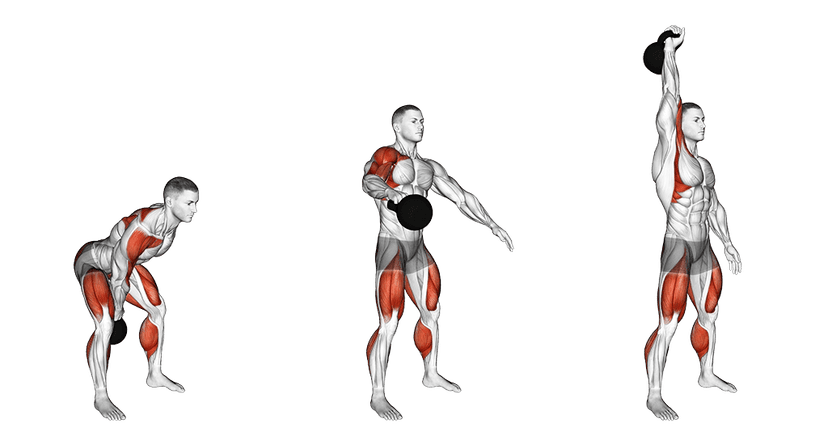
Kettlebell Snatch: Complete Guide
The kettlebell snatch is often considered the king of kettlebell exercises. This full-body ballistic movement propels the kettlebell from the ground to overhead in a single explosive motion. It combines power, cardiovascular endurance, and coordination in a format that requires just one tool. Fitness tests from many federations include the kettlebell snatch, and for good reason: it instantly reveals your overall athletic level.
This is an advanced exercise that requires solid proficiency with the swing and clean before attempting it. If you have mastered those two movements, the snatch is the logical next step to take your training to the next level.
Muscles targeted
- Posterior chain (hamstrings, glutes, spinal erectors): drives the explosive hip extension
- Deltoids (anterior and lateral): stabilization overhead with a locked arm
- Trapezius and rhomboids: scapular control during the ascending phase
- Forearms and grip: maintaining hold throughout the ballistic movement
- Full core (abs, obliques, quadratus lumborum): force transfer and stabilization
- Quadriceps: knee extension during the propulsion phase
The snatch is a total-body exercise. Power comes from the hips, not the arms. If your shoulders fatigue before your hips, your technique needs correction.
Proper execution
Starting position
Stand with feet shoulder-width apart or slightly wider. The kettlebell sits on the floor between your feet, slightly forward. Hinge at the hips, pushing them back, keeping a flat back, and grab the handle with one hand. The free arm stays by your side or slightly out for balance.
Phase 1: Backswing
- Swing the kettlebell between your legs like a standard swing.
- Your hips push back and your knees bend slightly.
- Your forearm contacts the inner thighs as the kettlebell passes behind you.
Phase 2: Explosive extension
- Drive your hips forward with force (hip drive).
- The kettlebell rises using the momentum generated by the hips, not by pulling with the arm.
- When the kettlebell reaches chest height, pull your elbow slightly back.
Phase 3: Punch through
- As the kettlebell reaches above shoulder height, punch your hand toward the sky.
- The kettlebell rolls smoothly around your wrist and settles on the back of your forearm with your arm locked overhead.
- Your arm is locked out, biceps near your ear, wrist straight.
- Hold for one second at the top (fixation).
Phase 4: Descent
- Let the kettlebell tip forward by bending your elbow.
- Bring the kettlebell in front of you, then absorb the motion by sending your hips back (backswing).
- Flow directly into the next rep.
Breathing: inhale during the backswing, exhale forcefully during the extension and punch through.
Common mistakes
1. Pulling with the arm instead of driving with the hips The arm only guides. Power comes 100% from the hips. Pulling with your arm fatigues the shoulders and biceps needlessly and risks tendinitis.
2. The kettlebell "crashes" on the forearm A trajectory that arcs too wide causes the kettlebell to slam onto your wrist at the top. The fix is to keep the kettlebell close to your body and punch through at the right moment. The kettlebell should roll gently, not crash.
3. Lumbar hyperextension at the top The lower back arches excessively when the kettlebell is overhead. Brace your abs and squeeze your glutes at the top to lock your pelvis in a neutral position. Your ribs should not flare open.
4. Bent wrist at the top The wrist bends backward under the kettlebell in the fixation position. Keep your wrist straight and aligned by gripping the handle firmly. The kettlebell rests on the heel of your palm, not on your fingers.
5. Uncontrolled descent Letting the kettlebell free-fall instead of guiding it into the backswing creates a dangerous jolt on the shoulder and lower back. Guide the descent with your arm and absorb with your hips.
Variations
Two-hand kettlebell snatch (beginner) A single kettlebell held with both hands, propelled overhead. Reduces coordination and grip difficulty. A good transition exercise between the swing and the snatch.
Kettlebell half snatch (intermediate) Identical to the full snatch but with an intermediate clean. The kettlebell stops in the rack position at the shoulder before being pressed overhead. Breaks down the movement for lifters who have not yet developed the fluidity of a direct snatch.
Dead snatch (advanced) The kettlebell starts from the floor on every rep instead of flowing continuously. Eliminates the stretch cycle and demands pure concentric power on each rep. Much more challenging.
Double kettlebell snatch (advanced) Two kettlebells simultaneously. Requires superior coordination and hip power. Reserved for experienced lifters with excellent shoulder mobility.
Programming
Placement in your session: The snatch goes at the start of your session when you are fresh. It is a technical, explosive movement that does not forgive fatigue. Never perform it at the end of a session when your technique degrades.
Volume and intensity:
- Beginner: 3 x 5 reps per arm, absolute technique focus
- Intermediate: 5 x 5-8 reps per arm, or EMOM protocol (every minute on the minute)
- Advanced: 10 x 10 reps per arm (classic 10-minute test with 24 kg for men)
Frequency: 2-3 times per week. The snatch is demanding on the nervous system. Alternate with swing or clean days to vary the intensity.
Starting weight: 12 kg for women, 16 kg for men. Master 10 reps per arm with no wrist issues before increasing the load.
Key takeaways
- Hips, not arms: power comes from explosive hip extension
- Punch through: drive your hand skyward to prevent the kettlebell from crashing on your wrist
- Solid fixation: locked arm, straight wrist, braced abs at the top
- Prerequisites: master the swing and clean before attempting the snatch
- Progression: start light and only increase the weight when your technique is smooth
