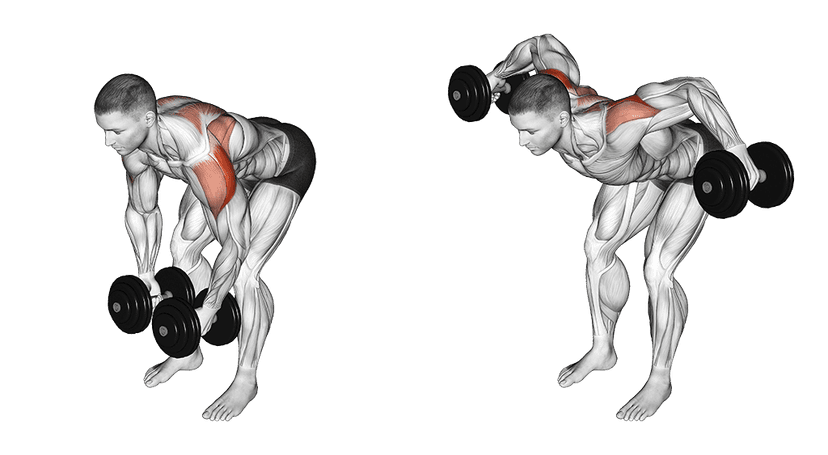
Bent-Over Reverse Fly: Complete Guide
The bent-over reverse fly is the go-to exercise for isolating the posterior deltoid. This rear shoulder head is often neglected in favor of the anterior and lateral heads, creating a visible and functional imbalance. If your shoulders appear to roll forward or you experience rotator cuff discomfort, there is a strong chance your rear delts are underdeveloped.
This seemingly simple exercise demands precise technique. The bent-over position makes it easy to cheat with the back or traps, and many lifters never actually feel their rear delts working. This guide gives you the keys to fix that.
Targeted Muscles
- Posterior deltoid: primary mover, responsible for horizontal arm extension
- Rhomboids: scapular retraction
- Middle and lower trapezius: assistance with scapular retraction
- Infraspinatus and teres minor: external shoulder rotation (stabilization)
- Spinal erectors: maintaining the bent-over posture
The posterior deltoid is a small muscle. It does not need heavy loads to be stimulated. If you are using a weight that forces you to cheat, it is too heavy.
Proper Execution
Starting Position
Stand with feet hip-width apart. Hinge forward at the hips until your torso is nearly parallel to the floor (60 to 80 degrees of hip flexion). Slight bend in the knees to protect the lower back. Flat back, not rounded. Head in line with the spine, gaze toward the floor. Hold a dumbbell in each hand, arms hanging below the shoulders, elbows slightly bent, palms facing each other.
Concentric Phase (Lifting)
- Spread your arms laterally while keeping the elbows slightly bent.
- Raise the dumbbells to shoulder height, no higher.
- Squeeze your shoulder blades at the top. Imagine pinching a pencil between them.
- The movement originates from the back of the shoulder, not the hands.
- Exhale on the way up.
Eccentric Phase (Lowering)
- Lower the dumbbells under control over 2 to 3 seconds.
- Do not let your arms drop passively.
- Stop just before the dumbbells touch beneath your chest.
- Inhale on the way down.
Recommended tempo: 1 to 2 seconds up, 2 to 3 seconds down, brief squeeze at the top.
Common Mistakes
1. Standing up during the movement The more you straighten up, the more the movement resembles a regular lateral raise and the less the rear delt is recruited. Keep your torso at the same angle from start to finish.
2. Using the traps to lift the dumbbells If your shoulder blades ride up toward your ears, the traps are doing the work. The shoulder blades should come together horizontally (retraction), not rise vertically (elevation).
3. Swinging the dumbbells with momentum The reverse fly is a precision exercise, not a brute force one. If you need momentum from your torso, the weight is too heavy. Reduce it and focus on the rear delt contraction.
4. Fully extending the arms Locked-out arms put excessive pressure on the elbow joint. Always maintain a slight bend at the elbow (15 to 20 degrees).
5. Rounding the back A rounded back in a bent-over position compresses the intervertebral discs. Keep your back flat by engaging your abs and maintaining a natural lumbar curve.
Variations
Seated Bent-Over Reverse Fly (Beginner) Sit on the edge of a bench and lean your torso over your thighs. This position eliminates any cheating with the legs and stabilizes the trunk. Ideal for learning to feel the rear delt.
Incline Bench Reverse Fly (Intermediate) Lie face-down on an incline bench set to 30 to 45 degrees, feet on the floor. The bench supports your torso, which removes spinal erector fatigue and lets you focus exclusively on the rear contraction.
Single-Arm Supported Reverse Fly (Intermediate) One hand rests on a bench or rack while the other hand performs the fly. The support allows better isolation of each side and helps correct imbalances.
Resistance Band Reverse Fly (Beginner) Same movement with a band held between both hands. The progressive resistance of the band increases tension at peak contraction. Excellent for home workouts or warm-ups.
Program Integration
The bent-over reverse fly is an isolation exercise to place at the end of a shoulder session or at the end of a back/pull session. It can also serve as a light warm-up before heavy rows.
- Hypertrophy goal: 3 to 4 sets of 12 to 15 reps
- Joint health goal: 2 to 3 sets of 15 to 20 reps with a light load
- Frequency: 2 to 3 times per week (the rear delt recovers quickly because mechanical stress is low)
The posterior deltoid is often undertrained. If that applies to you, add 2 specific exercises per week (reverse fly plus face pulls or reverse pec deck) to catch up.
Key Takeaways
- Torso nearly parallel to the floor, flat back
- Light to moderate load, technique comes first
- Squeeze shoulder blades at the top (retraction, not elevation)
- Slight elbow bend at all times
- Full control on the descent
- Prioritize the rear delt to balance your shoulders
