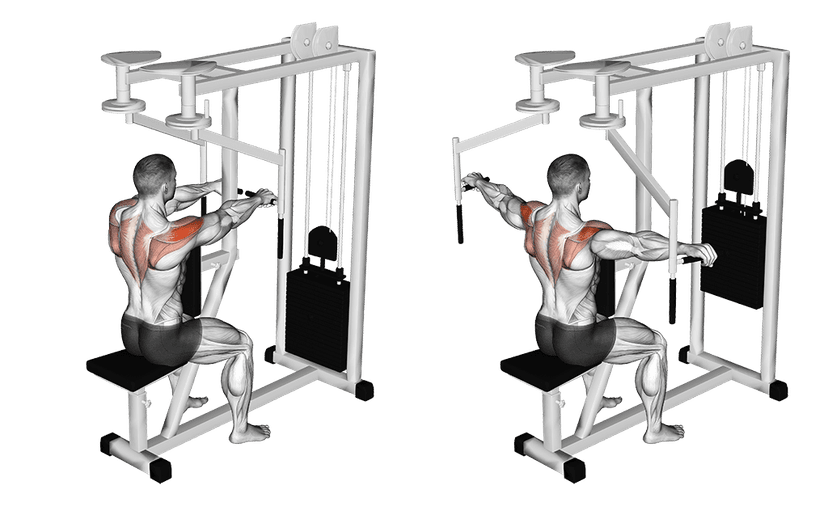
Reverse Pec Deck: Complete Guide
The reverse pec deck (or rear delt fly machine) is an isolation exercise for the posterior deltoid performed on the standard pec deck machine, but sitting face-first against the pad. It is one of the most effective and accessible exercises for targeting the back of the shoulders.
Its main advantage: the machine stabilizes your posture and guides the movement, letting you focus entirely on the rear delt contraction. No need to maintain a bent-over position, no lower back fatigue. It is the ideal exercise for those who struggle to feel their rear delts during free-weight movements.
Targeted Muscles
- Posterior deltoid: primary mover, responsible for horizontal extension
- Rhomboids: scapular retraction at the end of the movement
- Middle trapezius: assistance with scapular retraction
- Infraspinatus: external rotation and shoulder stabilization
- Teres major: slight assistance with horizontal extension
The reverse pec deck offers highly targeted posterior deltoid recruitment. The machine eliminates most compensations, making it a strong choice for beginners and advanced lifters alike.
Proper Execution
Machine Setup
Sit facing the pad (you are turned toward the back of the machine). Adjust the seat height so your arms are at shoulder height when you grip the handles. If the machine has a range-of-motion adjustment, position the arms at shoulder width or slightly narrower at the start.
Starting Position
Chest pressed against the pad. Feet flat on the floor. Grip the handles with a neutral grip (palms facing each other) or pronated grip (palms facing down), depending on machine configuration. Arms at shoulder height, elbows slightly bent. Shoulders down, not shrugged.
Concentric Phase (Opening)
- Spread your arms backward while keeping the elbows slightly bent.
- Open until your arms are in line with your shoulders (no farther).
- Squeeze your shoulder blades together at the peak of the movement.
- Hold for 1 second in the open position.
- Exhale during the opening.
Eccentric Phase (Return)
- Let your arms come forward while controlling the movement over 2 to 3 seconds.
- Do not let the plates drop. Maintain tension throughout.
- Stop just before the plates touch.
- Inhale during the return.
Common Mistakes
1. Using the arms instead of the shoulders If you are pulling with your hands and forearms, the rear delt is not doing the work. Think about initiating the movement with the back of your shoulders. Your hands are just hooks.
2. Shrugging the shoulders Shoulders rising toward the ears activate the traps at the expense of the posterior deltoid. Keep your shoulders low and pulled back throughout the entire set.
3. Opening too far back Forcing the range of motion beyond the shoulder line overloads the joint without additional benefit for the rear delt. Stop when your arms align with your shoulders.
4. Pulling the chest off the pad If your chest lifts off the pad, you are cheating with body weight. Stay glued to the pad from start to finish.
5. Loading too heavy The posterior deltoid is a small muscle. Loading too heavy forces compensation with the traps and back. Choose a weight that allows 12 clean reps.
Variations
High-Grip Reverse Pec Deck (Intermediate) Grip the handles in a higher position (if the machine allows) with elbows above shoulder height. This slightly changes the working angle and recruits more of the upper posterior deltoid.
Single-Arm Reverse Pec Deck (Intermediate) Work one side at a time with the free hand resting on your thigh. This allows you to focus on each side individually and correct imbalances.
Reverse Pec Deck with External Rotation (Advanced) In the open position, add an external wrist rotation (thumbs toward the ceiling). This extra movement recruits more external rotators (infraspinatus, teres minor). Excellent for shoulder health.
Reverse Pec Deck Drop Set (Intermediate to Advanced) Perform a heavy set (8 to 10 reps), then immediately reduce the load by 30 percent and continue without rest. This protocol intensifies muscle recruitment and creates significant congestion in the posterior deltoid.
Program Integration
The reverse pec deck fits at the end of a shoulder session, at the end of a back session, or even as a joint warm-up before heavy pulling movements.
- Hypertrophy goal: 3 to 4 sets of 12 to 15 reps
- Joint health and posture goal: 2 to 3 sets of 15 to 20 reps
- Strength-endurance goal: 3 sets of 20 reps with a slow tempo
- Frequency: 2 to 3 times per week
The reverse pec deck pairs perfectly with bent-over reverse flyes and face pulls for complete posterior deltoid work. You can rotate these three exercises throughout the week for varied stimuli.
Key Takeaways
- Chest glued to the pad from start to finish
- Movement initiated by the back of the shoulder, not the hands
- Shoulders down, shoulder blades squeezing at the peak
- Control the return phase over 2 to 3 seconds
- Moderate load, prioritize the mind-muscle connection
- 1-second pause in the open position to maximize contraction
