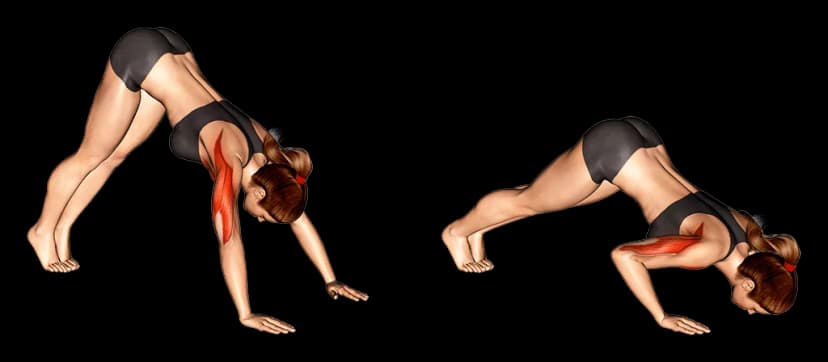
Pike Push-Ups: Complete Guide
Pike push-ups are a remarkably effective bodyweight exercise for targeting the shoulders. By simply changing the body angle compared to standard push-ups, you shift the load onto the deltoids and move closer to the overhead press movement pattern. They are the perfect exercise for building strong shoulders without any equipment, and a mandatory step on the road to handstand push-ups.
Whether you train at home, on the road, or in a gym, pike push-ups deserve a spot in your program. They let you develop vertical pushing strength with zero equipment investment.
Muscles targeted
- Anterior deltoids: primary movers, handling the upward push
- Lateral deltoids: stabilize the shoulder and assist the press
- Triceps: responsible for elbow extension at the top of the movement
- Upper trapezius: stabilizes the scapulae during vertical pushing
- Serratus anterior: scapular protraction, essential for shoulder stability
- Pectorals (clavicular head): secondary contribution due to the angled position
The anterior deltoids handle the majority of the work. The higher your hips and the closer they are to your hands, the more the movement resembles a pure vertical press and the harder your shoulders work.
Proper execution
Starting position
Place your hands on the floor, slightly wider than shoulder width. Walk your feet back, then raise your hips as high as possible to form an inverted V with your body. Your arms and torso should be as aligned as possible. Your legs can bend slightly if your flexibility does not allow them to stay straight. Your head is in a neutral position, eyes looking toward your feet.
Eccentric phase (descent)
- Bend your elbows, letting them flare out at roughly 45 degrees.
- Lower the top of your head toward the floor, between your hands.
- Control the descent over 2-3 seconds.
- Lower until your head nearly touches the ground or comes within a few centimeters.
Concentric phase (push)
- Push firmly through your hands to drive back up.
- Exhale during the effort.
- Return to the starting position with arms extended and hips high.
- Do not release shoulder tension at the top of the movement.
Breathing: inhale on the way down, exhale as you push.
Common mistakes
1. Hips too low If your hips drop, you turn the movement into a regular push-up and lose the shoulder work. Maintain the inverted V throughout the movement. Your hips must remain the highest point of your body.
2. Elbows flaring backward Sending your elbows behind you rather than to the sides overloads the triceps and reduces range of motion at the shoulders. Point your elbows at 45 degrees, just as you would for an overhead press.
3. Head dropping in front of the hands If your head travels in front of your hands rather than between them, you lose the vertical angle. Move your hands slightly forward or bring your feet closer to correct the path.
4. Rounded back A rounded back in the pike position compromises stability and reduces force transfer. Keep your back as straight as possible with active shoulder blades.
5. Incomplete range of motion Stopping halfway to avoid difficulty. Lower until your head is close to the floor. If you cannot manage that, elevate your hands on a step to reduce the range before progressing.
Variations
Feet-elevated pike push-ups (intermediate) Place your feet on a bench, chair, or step. The steeper angle increases the load on the shoulders. This is the intermediate step before wall handstand push-ups.
Pike push-ups on handles (intermediate) Place your hands on two supports (parallettes, push-up handles, or dumbbells) to increase range of motion. Your head can descend below your hands, which intensifies the deltoid work.
Wall pike push-ups (advanced) Walk your feet up a wall until your body is nearly vertical. This is the final progression before full handstand push-ups. The angle forces the deltoids to support almost your entire bodyweight.
Eccentric pike push-ups (beginner) If you do not yet have the strength to push up, focus on the descent over 5-6 seconds. Drop to your knees at the bottom and reset at the top. Excellent for building baseline strength.
Programming
Placement in your session: At the start of a shoulder or Push session when this is your main movement. In the middle of a session if you have an overhead press or dumbbell press first.
Volume and intensity:
- Beginner: 3 x 6-8 reps, focus on technique and range of motion
- Intermediate: 4 x 8-12 reps, feet on the floor
- Advanced: 3-4 x 8-12 reps, feet elevated or on handles
Frequency: 2-3 times per week. Shoulders recover well if per-session volume stays reasonable. Alternate with other shoulder movements to avoid monotony.
Progression: Start with feet on the floor, then feet elevated, then feet on the wall. When you can perform 4 x 12 with feet elevated and full control, you are ready for assisted handstand push-ups.
Key takeaways
- Inverted V position: hips high to maximize shoulder work
- Head between the hands: vertical path, not forward
- Elbows at 45 degrees: not tucked in, not fully flared
- Full range of motion: lower your head all the way to the floor
- Logical progression: floor, feet elevated, wall, handstand push-ups
